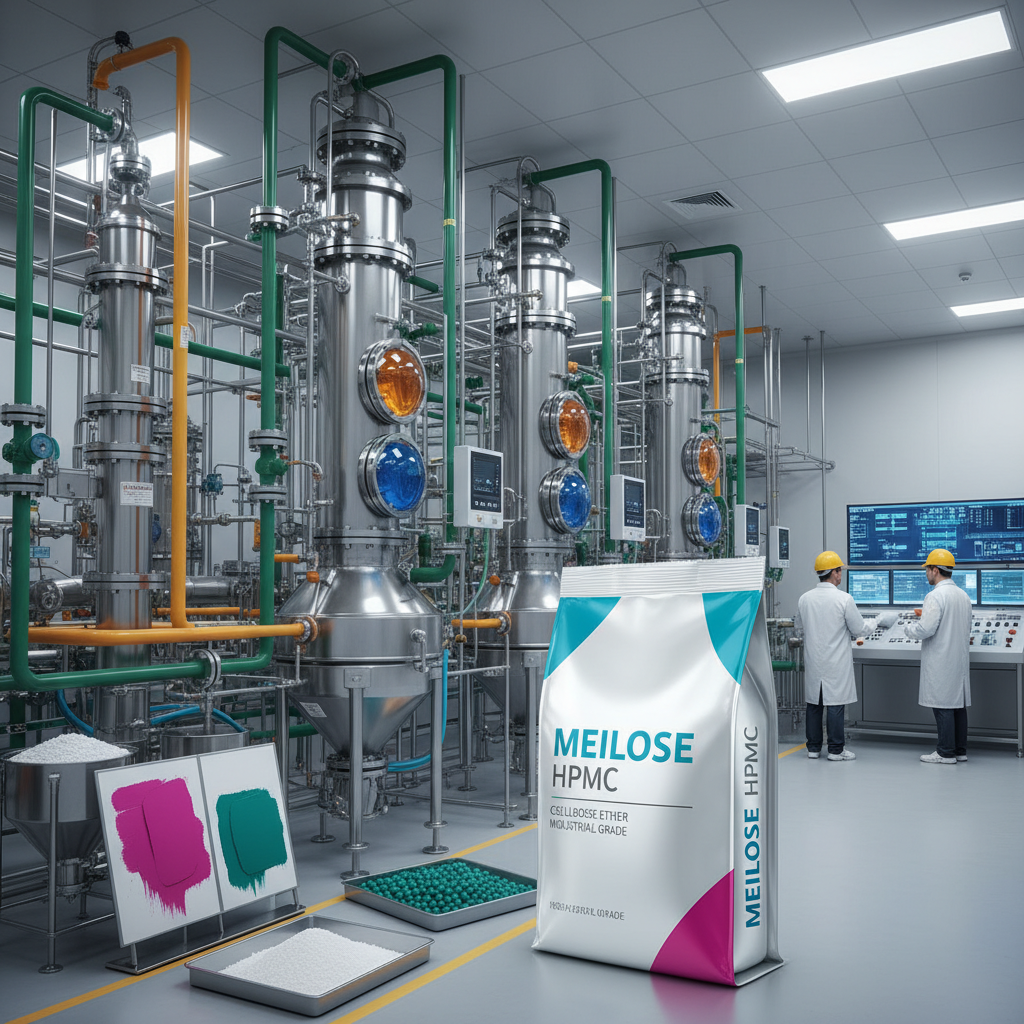
Selecting a reliable chemical supplier often comes down to understanding the precise balance between polymer viscosity and application stability. For industrial procurement officers, the search for a qualified hpmc factory is not merely about finding a vendor, but about securing a consistent chemical grade that prevents structural failures in construction and instabilities in personal care products.
Hydroxypropyl Methylcellulose (HPMC) serves as a critical additive across diverse sectors, acting as a thickener, binder, and water-retaining agent. The technical variance between a construction-grade powder and a detergent-grade polymer can be the difference between a crack-free wall and a failed architectural project, or a stable shampoo and a separating liquid.
This analysis examines the technical benchmarks of HPMC production, the critical selection criteria for different industrial applications, and how modern manufacturing standards influence the final performance of the chemical in real-world environments.


HPMC is synthesized through the etherification of cellulose, typically derived from refined cotton or wood pulp. The process involves treating cellulose with sodium hydroxide and reacting it with methyl chloride and propylene oxide. This chemical modification transforms a natural polymer into a versatile industrial tool capable of controlling the rheology of aqueous solutions.
In a professional manufacturing environment, the degree of substitution (DS) and the molar substitution (MS) are tightly controlled. These parameters determine whether the resulting powder will act as a high-viscosity thickener for shampoo or a water-retaining agent for cement mortar, making the precision of the factory's reaction vessels paramount.
Not all HPMC is created equal. The industry categorizes these polymers into specific grades based on their intended use. For example, Building Grade HPMC is engineered for high water retention and open-time extension in cementitious materials, whereas Detergent Grade HPMC focuses on stability in high-surfactant environments and clarity in liquid soaps.
Another critical distinction is found in MHEC (Methyl Hydroxyethyl Cellulose), which offers different thermal gelation properties compared to standard HPMC. This makes MHEC particularly suitable for applications requiring higher temperature stability, such as certain external wall adhesives or specialized industrial coatings.
Technical evaluation usually focuses on three metrics: viscosity (measured in mPa.s), ash content, and pH value. A high-performance factory ensures that these specs remain consistent across batches to prevent "batch-to-batch variance," which can lead to catastrophic failure in automated mixing plants.
In the construction sector, the primary challenge is the rapid evaporation of water from mortar, which leads to shrinkage cracks and reduced compressive strength. HPMC solves this by forming a hydrogel layer that traps water molecules, slowing down the hydration process of cement.
The efficacy of HPMC in mortar is measured by its ability to maintain pumpability and spreadability while preventing the "sagging" of materials on vertical surfaces, directly impacting the long-term durability of the structure.
Beyond water retention, HPMC acts as a lubricant. In putty powders and gypsum plasters, it improves the "slip" of the trowel, reducing the labor required for application and ensuring a smoother surface finish. When combined with RDP-VAE (Redispersible Polymer Powder), the result is a flexible, high-strength bond that resists environmental stress.
Depending on the end-use, the required functional properties of HPMC shift significantly. In tile adhesives, the priority is the "open time"—the window during which the tile can be repositioned. In contrast, in the coating industry, the focus shifts to dispersion and stabilization, ensuring that pigments remain evenly distributed without settling.
To visualize these requirements, we can look at a relative importance index. While water retention is the dominant factor for construction, rheology control is more critical for personal care products like hand sanitizers or shampoos.
Consider a typical industrial setting where a contractor is applying exterior wall adhesive putty in high-temperature conditions. Without the correct grade of HPMC, the water in the mix would evaporate too quickly, causing the putty to crack and lose its bond with the substrate. By utilizing a high-viscosity, water-retaining grade, the contractor ensures the slurry remains workable for a longer period, significantly reducing material waste and rework.
Similarly, in the ceramic manufacturing process, HPMC acts as a vital binder. It provides the necessary green strength to ceramic pieces before they are fired in the kiln, preventing deformation and ensuring a high yield of quality products. This demonstrates that while the chemical is the same, its role shifts from a "water manager" in construction to a "structural binder" in ceramics.
The industry is currently moving toward "application-specific" synthesis. Rather than producing a general-purpose HPMC, factories are now tailoring the substitution patterns to meet extreme environmental demands, such as salt-resistant grades for coastal construction or low-foaming grades for specialized detergents.
Another shift is the integration of sustainable raw materials. There is an increasing demand for cellulose ethers derived from certified sustainable forests, pushing manufacturers to audit their supply chains more rigorously to meet global environmental standards.
Furthermore, the move toward digitalization in the hpmc factory environment allows for real-time monitoring of the etherification process. This reduces the margin of error in viscosity control, ensuring that the final product's performance is predictable regardless of the batch size.
For procurement managers, the challenge lies in balancing cost with technical reliability. A lower price per kilogram can be an illusion if the polymer's water retention is inconsistent, leading to higher failure rates on the job site or in the production line.
The most effective evaluation method is to move beyond the technical data sheet (TDS) and conduct application-specific testing. This involves measuring the "open time" in actual mortar mixes or the "stability index" in soap liquids under varying temperature conditions.
The following framework provides a relative assessment of the factors that should drive the selection process based on the intended end-product.
| Application | Primary Driver | Technical Risk | Evaluation Metric |
|---|---|---|---|
| Tile Adhesive | Open Time | Rapid Drying | Water Retention % |
| Wall Putty | Workability | Surface Cracking | Viscosity (mPa.s) |
| Coatings | Stability | Pigment Settling | Dispersion Rate |
| Detergents | Clarity | Phase Separation | Solubility Speed |
| Ceramics | Binding Power | Green-state Breakage | Tensile Strength |
| Sanitizers | Texture | Viscosity Drop | Rheological Profile |
Building Grade HPMC is specifically optimized for water retention and sag resistance in cement-based materials, focusing on preventing rapid dehydration of mortar. Detergent Grade HPMC is designed for stability in the presence of high concentrations of surfactants and salts, ensuring that the viscosity of liquid soaps or shampoos remains constant without causing turbidity or phase separation.
HPMC creates a high-viscosity hydrogel network within the adhesive. This network slows down the migration of water from the adhesive into the tile or the substrate. By maintaining moisture at the interface for a longer duration, the adhesive remains "wet" and tacky, allowing the installer more time to adjust the tile before the material sets.
MHEC (Methyl Hydroxyethyl Cellulose) typically exhibits higher thermal stability. In hot climates or projects where materials are exposed to extreme heat during application, MHEC resists viscosity loss more effectively than standard HPMC. This prevents the mortar from becoming too thin and losing its water-retaining properties in high-temperature environments.
Yes, indirectly. Because HPMC improves the lubricity and spreadability of the mix, it enhances the efficiency of the binder. By improving the bond strength and reducing the incidence of shrinkage cracks, it allows the formulator to optimize the cement-to-sand ratio without compromising the overall mechanical integrity of the finished wall or floor.
Low-quality HPMC often suffers from poor solubility or inconsistent viscosity. In coatings, this can manifest as "fish-eyes" (small lumps of undissolved polymer) on the painted surface or instability where the paint separates in the can. This not only ruins the aesthetic finish but can also lead to uneven coating thickness and reduced weather resistance.
Viscosity is typically measured using a Brookfield viscometer. A specific percentage of HPMC powder is dissolved in distilled water at a controlled temperature (usually 20°C or 25°C). The torque required to rotate a spindle at a set speed is measured, and the result is recorded in centipoise (cP) or mPa.s, which serves as the primary benchmark for grade verification.
The role of HPMC has evolved from a simple additive to a precision-engineered component of modern material science. Whether it is ensuring the longevity of a skyscraper's exterior or the stability of a consumer cosmetic, the quality of the chemical depends entirely on the technical rigor of the manufacturing process.
For industrial buyers, the focus must shift from price-per-unit to performance-per-application. By aligning the specific grade of HPMC—be it for construction, coatings, or detergents—with the actual environmental stressors of the end-use, manufacturers can ensure higher product quality and lower long-term operational costs.